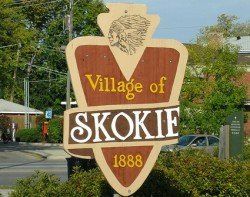
One of the biggest Supreme Court landmark cases that has to do with the first amendment is the National Socialist Party of America v. Village of Skokie case. In 1977, near Chicago and its surrounding suburbs, Frank Collin and the National Socialist Party of America would regularly hold demonstrations while displaying swastikas. Looking for new areas to hold marches and demonstrations, Collin and the National Socialist Party of America sent out letters to different suburbs of Chicago looking for permits for the group to hold a white power demonstration. Most of the suburbs ignored the letters, but one suburb, a town called Skokie was home to a number of people who are Jewish decided to file an injunction and passed three ordinances. Collin used the ordinances to claim that his first amendment rights were being infringed and held protests outside of the village hall in Skokie for his right of free speech. The town had passed an emergency injunction and the demonstrators were prohibited from wearing Nazi uniforms and swastikas. The American Civil Liberties Union challenged the injunction on behalf of the NSPA and the case went to the Supreme Court.
Legally, this was an issue that directly has to do with the right to free speech and assembly. The final verdict decided that the ordinances set in place by Skokie was unenforceable and unconstitutional, meaning that the NSPA would be allowed to march and display the swastika in Skokie. This decision would have a lasting impact on society because it would support the idea that hate speech is protected by the first amendment. While it would appear that this decision protects controversial hate groups, it is apparent that all minority groups are affected by the outcome of this case. It is important to note that there are two sides to be argued when looking at the decision, the aftermath of the decision, and the possibility of the case ever being overturned.
The decision to go against the ordinances set by Skokie is heavily influenced by the approach that the justices take when looking at the application of the first amendment. The result of this case would indicate that the justices involved looked at the first amendment somewhat from an absolutist approach. The book Media Law and Ethics looks at the approaches to applying the first amendment and states, “Some people have described themselves as absolutists, holding that the First Amendment was intended to prevent Congress from making any law that restricted free speech” (Moore, 95). The absolutist approach is the more likely approach used in this situation because it states that no law can be made that would restrict free speech. This is controversial because it protects speech that is offensive such as protecting the right to wear swastikas is a mostly Jewish Neighborhood.
The decision to allow this speech in Skokie comes with its own benefits and its own drawbacks. It is important to allow the free speech of all so that no minority group is left unrepresented when it comes time for them to have a say in the government. The ability for all to freely express their political views without interference from the government is another good thing that comes from this decision. This leaves the ability for those to voice their opinions no matter how unpopular without legal repercussions. Where this decision lacks is its ability to protect the people, who are hurt by the speech of others. In this situation, the people of Skokie can have feelings of uneasiness and genuinely not feel safe while neo-Nazis are demonstrating where they live. While it may seem unethical for neo-Nazis to demonstrate in a Jewish neighborhood, the Supreme Court decided that it goes against the first amendment for Skokie to put laws in place preventing this from happening.

While this decision did not go in favor for the people of Skokie, there is ethical consideration that can be applied to a situation like this one. In the book Media Law and Ethics, the idea that different ethical approaches can be applied to law is discussed. One approach that I believe applies to this situation is the teleological approach, which states, “The ethical decision is the one that produces the greater good, presumably for the most people, or alternatively, the greater good for the decision- maker” (Moore, 118). The use of this approach in this situation would mean that even though the people of Skokie are losing in the short term this is the best possible outcome because of the alternatives. For example, had this case been decided with the opposite verdict, the people of Skokie would feel safe however there are many other groups that would suffer in their place. This would happen because it would be possible for any group of people to be oppressed due to the fact that they do not have access to their full first amendment rights. However, it is also a point to note that it is unfair for the people of Skokie to have to suffer for the greater good of others.
In the event that this case becomes overturned by the current SCOTUS, the entire world would be different. It would be hard for any minority group to express their political views freely, but it would also mean that there is a more action taken against assaultive language or fighting words. In an article titled, Skokie Revisited: Hate Group Speech and the First Amendment, the idea of fighting words is described in the context of this court case and applied to the decision. “In 1942, the Supreme Court in Chaplinsky v. New Hampshire defined fighting words as forms of expression “which by their very utterance inflict injury or tend to incite an immediate breach of the peace” (Downs, 631). The use of the fighting words doctrine as a defense to decide what speech violates the first amendment would expand and I think that more speech would apply as fighting words than in the past.
In an article titled Nazis in Skokie: Fighting Words or Heckler’s Veto?, by Mark A. Rabinowitz, the idea of what should be considered fighting words in this situation is discussed. “In so holding, the Court reiterated its earlier conclusion that the Fighting Words Doctrine is limited to situations in which the expression is “likely to produce a clear and present danger of a serious substantive evil that rises far above public inconvenience, annoyance, or unrest” (Rabinowitz, 267). While the Supreme Court at the time decided that the NSPA did not present fighting words, an overturned verdict might reopen a discussion of what counts as fighting words.
While all hate speech and hate groups would be hindered so would the rest of any other minority groups who are not promoting hate speech. Even though what is being said by hate groups is controversial, it is important that they are allowed to express themselves because if one group is being repressed then all smaller groups even ones that do not promote hate speech would be repressed. The constitution protects all citizens not just the ones that we do not disagree with. If something were to happen in today’s society that is related to the protection of this kind of speech under the first amendment and this case were brought up it should not be overturned because it would oppress and apply to too many. It is not right to take away the freedoms of those who are not affiliated with hate groups just because of the hate groups that promote this kind of speech.
Works Cited
Rabinowitz, Mark A. “Nazis in Skokie: Fighting W Nazis in Skokie: Fighting Words or Heckler Ds or Heckler’s Veto? .” DEPAUL LAW REVIEW, vol. 28, no. 2, 1979.
A. Downs *, Donald. “Skokie Revisited: Hate Group Speech and the First Amendment.” Conscience, Expression, and Privacy, 2018, pp. 47–103., doi:10.4324/9781315053615-4.
Moore, Roy L., et al. Media Law and Ethics. Routledge, 2021.
 Christian's blog